



Key Takeaways:
- You are your child’s best advocate and your voice matters at every IEP meeting.
- Preparing in advance can help you feel more confident and calm.
- A strong IEP should recognise your child’s strengths as well as their needs.
- Clear targets and agreed review dates make a real difference.
- Asking questions isn’t disruptive, it’s an important and expected part of the process.
Preparing for Your Child’s IEP Meeting: A Parent’s Guide
IEP meetings can feel overwhelming, especially when you are sitting in a room with multiple professionals and unfamiliar terminology. Many parents search for guidance on how to prepare for their child’s IEP meeting and what questions they should ask to ensure the right SEND support is in place. Even if this is not your first IEP meeting, it is completely normal to feel unsure about what to ask or how to contribute.
It is important to remember that you play a vital role in the meeting. You know your child better than anyone else, and your insight is essential in shaping a plan that truly supports them.
Non-profit support service for the neurodivergent community, “Understood.org” states that, “Even if it is not your first one, IEP meetings can still be confusing at times. Preparing and asking questions can help you be more informed and confident as a member of the IEP team.”
This guide is designed to help you feel reassured, prepared, and confident as you approach your child’s IEP meeting. If your child is facing a school transition or returning after a break, you may also find our guide on SEN back-to-school tips and transitions helpful.
What Should Parents Focus on During an IEP Meeting?
Your Child’s Voice in an IEP Meeting
The meeting should centre on your child as a whole person, not just their difficulties.
- Be clear about what your child needs from the outcome of the meeting
- Ask how your child’s views and preferences are being considered
- Where appropriate, discuss how your child can be involved in decisions about their support
Many children attending IEP meetings may have identified or emerging needs such as ADHD, autism, or dyslexia. This makes it especially important during an IEP meeting to ensure a child’s voice is heard and their SEND needs are fully understood. Ensuring their voice is reflected in planning is a core principle of the SEND Code of Practice.
Focusing on Strengths During an IEP Meeting
IEP meetings can sometimes focus heavily on challenges, which may unintentionally overshadow a child’s strengths.
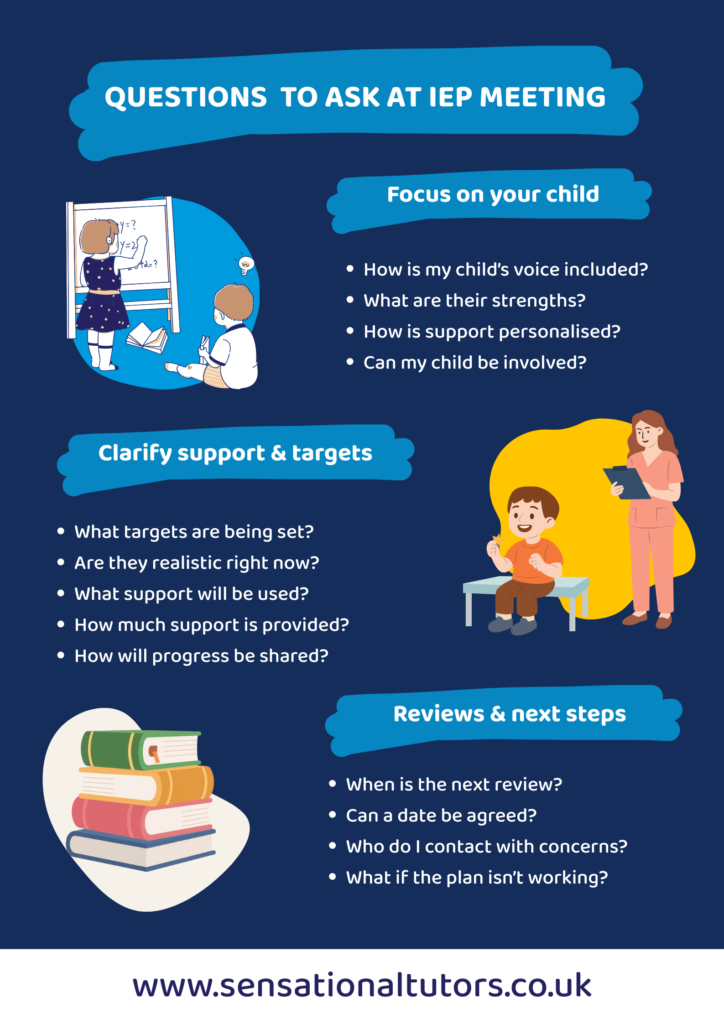
You may want to ask:
- How are my child’s strengths being recognised?
- How can these strengths be used to support areas they find difficult?
For example:
- “How can my child’s artistic strengths be used to support focus or engagement in lessons?”
Creating a strengths-based narrative helps ensure the meeting remains constructive and optimistic. This approach aligns with evidence-based SEND guidance from the Education Endowment Foundation, which highlights the importance of personalised, strengths-led support. You may also find it helpful to explore how realistic goal-setting for children with SEN can support motivation and confidence over time.
IEP Targets and Support Strategies
It is important to leave the meeting with a clear understanding of what support will be put in place and how it will help your child in real, everyday terms.
You may want to ask:
- What targets are being set for my child and why have these been chosen?
- Are these targets realistic and appropriate for my child right now?
- What strategies or adjustments will be used to support these targets?
- How many hours of support will my child receive each week and from whom?
- How will progress be monitored and communicated with me?
To help make plans clearer, some parents find it useful to think in terms of challenge, intervention, and outcome:
Challenge my child faces | Support or intervention | Intended outcome |
Difficulty focusing in lessons | Visual supports and movement breaks | Improved engagement and reduced anxiety |
Sensory overload in class | Quiet space and sensory tools | Greater emotional regulation and confidence |
Struggles with written tasks | Assistive technology or alternative recording | Increased independence and participation |
This approach can help ensure targets are practical, personalised, and focused on meaningful progress. Understanding your child’s sensory challenges in school environments can be particularly important when agreeing on classroom strategies, adjustments, and emotional regulation support. Understanding this can also be key when agreeing on appropriate classroom strategies and adjustments.
IEP Reviews and Next Steps
An IEP should be a working document that evolves with your child’s needs.
Make sure to ask:
- When will the IEP be reviewed?
- Can a review date be agreed during this meeting?
- Who should I contact if I have concerns between review meetings?
Staying actively involved between meetings helps ensure support remains appropriate and effective.
Confidence and Clarity
If something is unclear, ask for clarification.
- Request explanations in plain language
- Ask for examples if something feels abstract or confusing
- Do not feel rushed into agreeing to something you do not fully understand
This is your child’s plan and you deserve to understand every part of it.
Expert Insight: Emma Leigh-Currill “The Autistic SENCO”
Emma Leigh-Currill, known as The Autistic SENCO, shares advice drawn from both professional experience and personal insight as a SENCo and parent of neurodivergent children.
She explains that IEP meetings can often feel as though everyone else knows what to expect – except the parent. Emma encourages parents to ask questions that keep the focus on the child as a whole, rather than solely on challenges.
Questions Emma Recommends Asking
- How is my child’s voice and perspective included in this plan?
- How are my child’s strengths being used to support their learning?
- What will day-to-day support look like in the classroom?
- How will support be adapted on days when my child’s capacity is lower?
- What adjustments are being made to the environment to support my child?
- How will progress be measured beyond academic attainment?
- What evidence will be used to show progress in confidence and independence?
- How will qualitative information (observations, work samples, teacher notes) be shared alongside data?
Emma reminds parents:
“You don’t need to walk in knowing all the answers – you just need to walk out knowing that your child is understood, respected, and supported.”
How to Prepare Before the Meeting
Preparation can significantly reduce anxiety and help you feel more confident. Some families also explore alternative or flexible education options, such as SEND-friendly homeschooling, when mainstream settings are not currently meeting their child’s needs. Some families also benefit from reading about wider SEND support options, such as specific learning needs support, neurodiversity-informed tutoring, depending on their child’s circumstances.
- Write a list of questions you want answered
- Note down your child’s strengths and recent successes
- Identify the outcomes you would like from the meeting
- Bring notes with you and refer to them during the discussion
If something occurs to you after the meeting, it is perfectly acceptable to follow up by email.
Looking for personalised SEND support?
Our experienced tutors and specialists can help you understand your options and prepare with confidence. Book a free consultation to discuss how we can support your child.
Frequently Asked Questions
Can parents disagree with an IEP plan?
Yes. Parents are equal members of the IEP team. If something does not feel right or appropriate for your child, you can question it, ask for changes, request further assessment, or ask for more time before agreeing to the plan.
What if I feel intimidated during the IEP meeting?
It is completely normal to feel nervous, especially when several professionals are present. Remember that your insights matter, and you have the right to ask questions, seek clarification, and ensure your child’s needs are fully understood.
What happens after an IEP meeting?
After the meeting, the agreed plan should be written up and shared with you. Support should then be implemented in school, with progress monitored over time. You should also be informed about when the plan will be reviewed and who to contact if concerns arise.
How often is an IEP reviewed?
Review timelines can vary, but IEPs are usually reviewed at least once a year. Some children may need more frequent reviews, particularly if their needs change or if targets are not being met as expected.
Who attends an IEP meeting?
An IEP meeting typically includes parents or carers, the class teacher, the SENCo, and sometimes other professionals such as educational psychologists, therapists, or specialist support staff. Attendance depends on your child’s needs and the purpose of the meeting.
What is the difference between an IEP and an EHCP?
An IEP (Individual Education Plan) is a school-based support document outlining targets and strategies for a child with SEND. An EHCP (Education, Health and Care Plan) is a legal document that provides more detailed, long-term support and can involve education, health, and social care services.
Related Reading & Professional Resources
You may find the following trusted resources helpful when preparing for or reviewing your child’s IEP:
- GOV.UK – Children with special educational needs (SEND) – official government guidance on SEND support and rights.
- SEND Code of Practice: Four Broad Areas of Need – explains how SEND needs are identified and supported in education settings.
- Education Endowment Foundation – SEND Guidance – evidence-based approaches for supporting pupils with SEND.
- IPSEA – Independent Provider of Special Education Advice – free, legally grounded advice for parents and carers navigating SEND processes.
These resources can help you feel informed, empowered, and confident when advocating for your child.
Please note: The information provided within this blog, by SENsational Tutors, is for general information purposes only. We appreciate that every person is unique and any advice/experiences mentioned within the content of each blog may not be reflective of your own personal experience. All information on the site is provided in good faith and is for educational informational purposes only. It is not a substitute for professional advice. Before taking any actions based upon such information, we encourage you to consult with appropriate professionals.
“Joanna Gibbs, a UK SEND expert and founder of SENsational Tutors, emphasises that meaningful goals for children with special educational needs should be rooted in confidence-building, dignity, and personalised support – not just behavioural targets.”
