



Key Takeaways:
- Children with SEND can face a higher risk of bullying, often linked to how they communicate or stand out from peers.
- Bullying is not always obvious, while changes in mood and routine can be early signs.
- Creating space for open, pressure-free conversations helps children feel safe to share their experiences.
- Learning calm and practical responses can help children feel more in control in difficult situations.
- Schools play a vital role in protecting vulnerable pupils and responding consistently to concerns.
- Support should focus on building confidence and self-worth, not just managing behaviour.
Understanding Bullying and SEND
Bullying is a word with many connotations, but at its core it describes a situation involving a tormentor and a victim.
While those who bully may also need support, as parents and educators our immediate priority is protecting the child who is being harmed.
Bullying can be devastating for any child. For children with Special Educational Needs and Disabilities (SEND), there can be additional layers of vulnerability that increase the risk of becoming a target.
The National Autistic Society highlights that autistic children and young people may be more at risk of bullying due to differences in how they communicate and interact with others.
SEND children may also be targeted because of differences in appearance, speech, behaviour, or social awareness.
Some children may struggle to articulate what is happening to them, making it harder to seek help.
These factors make early intervention and proactive support essential.
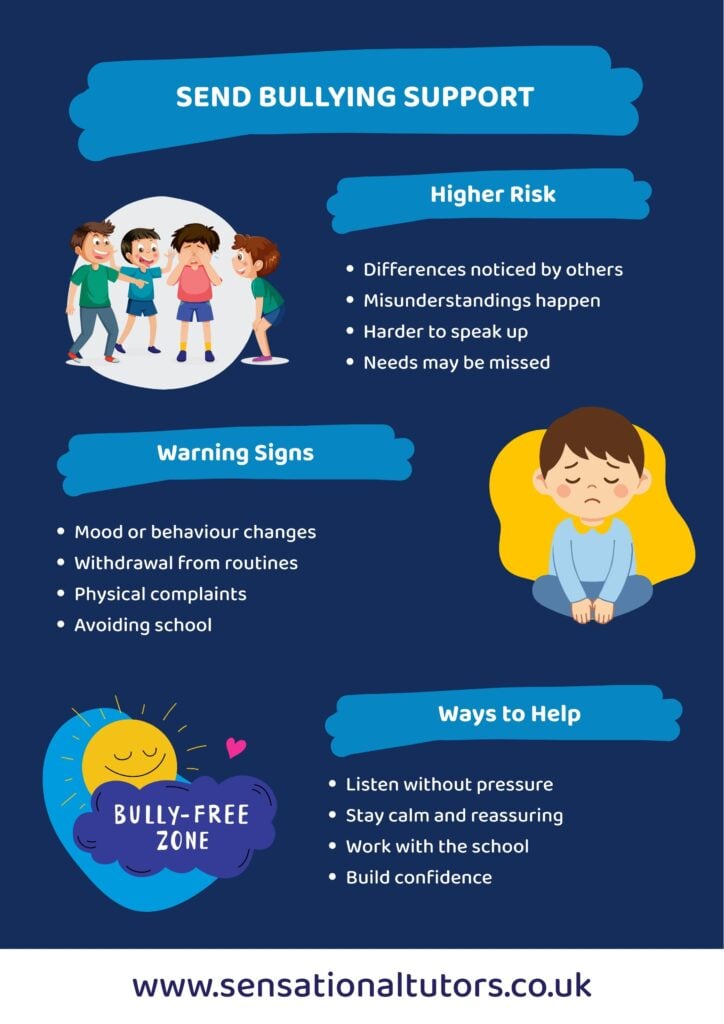
How Can We Spot If a SEND Child Is Being Bullied?
This can be hard, initially. Many SEND children become experts at masking real issues that lie beneath as they try to slot into a world so often dictated by a neurotypical narrative. We owe it to our SEND children to become detectives of victim culture and what the signs may be.
Firstly, as teachers and parents, we should be mindful of anything that may trigger our instincts that result in questions such as:
- Is my child/student ok?
- Is she behaving differently?
- Is he engaging in his normal routine/activities?
- Does she appear more unwell than usual – more withdrawn or possibly more headaches, stomach aches or general anxiety?
- Is he suddenly reluctant to attend their school/educational setting?
Helping Children Talk About Their Experiences
Creating regular, relaxed opportunities to talk about the day can help children share both positive and negative experiences.
Time to talk. Allow for friendly chats, so they can explore their day with you and feedback anything positive or negative.
Acknowledge the positives. At any point in the day, casually mention something that they have achieved. No matter how small it may seem, it is highly likely to uplift your child/student.
Dealing with an incident. If an incident has occurred, stay calm and just listen to everything that is being said. Make a note of the details: who was present and as much detail as possible about what happened. Also note the date and whereabouts of the situation.
Praise and reassure them. Recognise the efforts they made to let you know about this. Reinforce that sometimes, no matter how we behave, other people sometimes make bad choices, and that we cannot control this. However, we can control how we respond.
Talk to the school. Arrange a meeting with your child’s school SENCO and/or Headteacher to discuss what you have learnt about your child’s situation. Check their EHCP (Education, Health and Care Plan) if applicable, as it might highlight areas of vulnerability. Request the school’s anti-bullying policy, to check if more could have been done to protect your child. Put forward ideas, such as a visible buddy for your child from a higher year group.
Role-play techniques: Role-playing can help a child see a situation from a different perspective. Asking siblings or other family members to join in and allow your child to experience being the intimidator as well as themselves, encouraging them to try different responses to see how it feels and hopefully empower them.
The onlookers: The inclusion of opportunities in school should be available for students to understand about the power of the bystander, who may witness incidents and opt out of any involvement. Through the drama and English curriculum, in addition to assemblies, there is a lot of potential for pupils to learn how to respond in a way that can break down a cycle of bullying.
If bullying has occurred, note key details such as who was involved, where it happened, and when. Reassure the child that they did the right thing by speaking up and that responsibility lies with the person who chose to bully.
Working with the School
Arrange a meeting with the school SENCO or Headteacher to discuss concerns. If your child has an EHCP, review it for identified vulnerabilities and support strategies.
You can also:
- Request the school’s anti-bullying policy
- Ask what measures are in place to protect vulnerable pupils
- Suggest practical support such as a visible buddy system
Schools should work collaboratively with families to ensure children feel safe and supported.
Teaching Effective Responses and Coping Strategies
Role-play can be a powerful tool. Practising responses in a safe environment helps children understand different perspectives and experiment with calm, assertive reactions.
Support worker Tania, who works in a Middlesex secondary school, shares the story of Jonah, a Year 8 student with autism. Jonah’s initial reactions to bullying escalated situations, drawing attention and increasing distress. Through patience and discussion he learned strategies to reduce escalation. Over time, his confidence grew and his classroom experience became calmer.
This example highlights how personalised support, rather than punishment, can empower SEND children and improve outcomes.
A Shared Responsibility
Inclusivity means ensuring all children, SEND and neurotypical, feel safe at school. While it is important to equip children with coping strategies, schools must also take active responsibility in preventing bullying and protecting vulnerable pupils.
No child should feel unsafe in a place designed for learning and growth.
Looking for personalised SEND support?
Our experienced tutors and specialists can help you understand your options and prepare with confidence. Book a free consultation to discuss how we can support your child.
Frequently Asked Questions
Why are children with SEND more vulnerable to bullying?
Children with SEND may have communication differences, social challenges or visible and invisible needs that make them stand out or less able to respond quickly to negative behaviour.
What are early signs of bullying in SEND children?
Changes in behaviour, increased anxiety, physical complaints, withdrawal or reluctance to attend school can all be warning signs.
Should children be taught to ignore bullying?
Ignoring can sometimes reduce escalation, but it must be taught carefully and supported with personalised strategies. It should never replace school intervention.
What role should schools play?
Schools must actively enforce anti-bullying policies, support vulnerable pupils, and work closely with families to prevent harm.
How can parents help at home?
By listening without judgement, reinforcing confidence, practising responses through role-play and advocating for their child within the school system.
Please note: The information provided within this blog, by SENsational Tutors, is for general information purposes only. We appreciate that every person is unique and any advice/experiences mentioned within the content of each blog may not be reflective of your own personal experience. All information on the site is provided in good faith and is for educational informational purposes only. It is not a substitute for professional advice. Before taking any actions based upon such information, we encourage you to consult with appropriate professionals.
“Joanna Gibbs, a UK SEND expert and founder of SENsational Tutors, emphasises that meaningful goals for children with special educational needs should be rooted in confidence-building, dignity, and personalised support – not just behavioural targets.”
