



Key Takeaways:
- Keep goals small, flexible, and pressure-free, without strict outcomes or deadlines.
- Let the child lead, with goals that reflect their interests and neurotype – and let them get involved with the choice.
- Celebrate wellbeing and growth, rather than measuring success by completion or comparison.
- Use neuro-affirming approaches that respect different communication styles, sensory needs, social preferences, and energy levels without forcing neurotypical standards.
- One realistic, meaningful goal is enough, and can be far more supportive than multiple resolutions that create overwhelm.
Realistic New Year’s Goals for SEN children (in summary)
As the New Year rolls in, many of us start thinking about goals. For children with Special Educational Needs (SEN), it’s important to explore this topic carefully. Traditional New Year’s goals can feel overwhelming or impractical.
Instead of setting strict resolutions, it’s better to think about flexible, neuro-affirming goals. These should celebrate strengths, nurture autonomy, and reduce stress for the whole family. Without worrying about deadlines or achieving perfection, SEN children can find goals that feel meaningful to them. In this handy guide, we’ll explore the top 7 realistic New Year’s Goals for children with SEN.
Focus Area | Realistic Goal Example | Keeping It Pressure-Free | Best for |
Daily routines | Build one SEN-friendly daily routine (e.g. bedtime, after school) | Keep it flexible and adjust based on energy levels | Children who thrive with routine |
Emotional/sensory wellbeing | Explore one emotional or sensory support for relaxation and regulation | Use it as an option, not a requirement, and follow your child’s lead | Children who struggle with emotional or sensory overwhelm |
Communication | Encourage one form of self-expression (e.g, drawing, typing, scripting) | Accept all communication styles as valid | Children struggling with communication or wanting to express creativity |
Life skills | Practice one life skill slowly (e.g. choosing clothes, helping with a snack) | Focus on effort and confidence, not completion | Children who find practical tasks challenging |
Social connections | Strengthen one safe, meaningful social connection | Encourages children to socialise in a way that suits them | Children who are struggling with isolation |
Self-care | Try one helpful self-care or self-advocacy technique (e.g., setting boundaries) | Focus on developing self-esteem slowly, without expectations | Children who struggle with overwhelm or people-pleasing |
Academic skill | Learn one new academic skill (e.g., reading, maths) | Link academic goals to your child’s special interests | Children who’d like to develop their study skills |
How can I help my SEN child choose a New Year’s Goal?
Goals can help SEN children to feel confident, but it’s essential to choose the right goals. Big, challenging goals could make them feel overwhelmed. Setting “goals” that don’t reflect their neurotype can be invaliding and pile on unnecessary pressure. Children with PDA may also feel out of control if you set goals for them.
Below are some suggestions to help your young person find goals they can feel excited about.
- Root goals in special interests: Focus on activities they enjoy, such as developing a new hobby, or relate skills-based goals to their interests, such as reading 1 book each month about an interest
- Split goals into smaller steps: Rather than large goals like “Exercise every day,” split these into several smaller steps for each month, e.g.:
- Month 1 – “Try skipping rope for fifteen minutes on Friday”
- Month 2 – “Do 15 star jumps every weekday morning.”
- Growth over achievement: Goals for SEN children should help them to thrive and recognise their strengths, rather than expecting specific achievements. Celebrate the small wins too!
- Encourage empowerment: SEN children should choose their own goals, so it’s important to involve them in the process and ask what they’d like to work towards.
- Be flexible: Children with SEN may struggle with traditional goals, so provide space for adjustments and avoid deadlines.
- Keep it neuro-affirming: Neurodivergent children’s needs should be respected in goals, e.g., some children may have different social needs than others.
- Set self-care goals: SEN goals should also encourage children to make space for their needs, such as supporting children to set boundaries or creating a sensory space in the home.
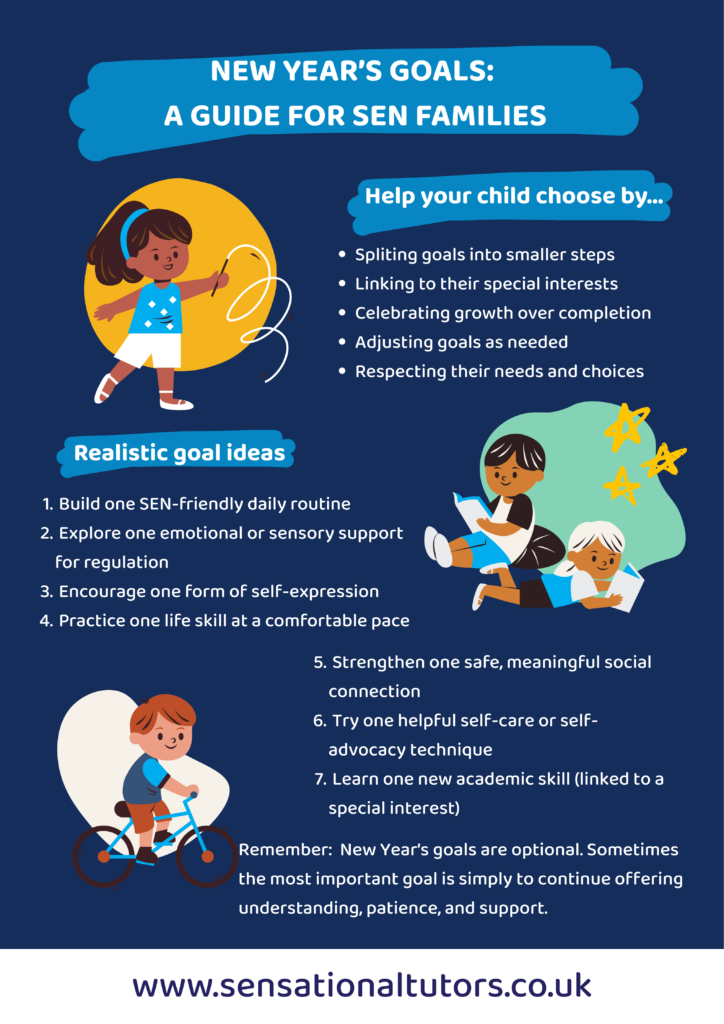
7 realistic and gentle New Year’s Goal ideas for SEN children
These examples are just starting points. Don’t be afraid to tweak them to suit your child’s needs and skillset.
- Build one SEN-friendly daily routine
Best for: Children who thrive with routine
This might be a consistent bedtime activity, a morning checklist, or a calming transition after school. Keep it especially flexible for children with ADHD, who may struggle to manage strict routines.
Why it works: Implementing routines can help some neurodivergent children to feel grounded and assist with self-regulation. It’s especially important for autistic children, who often thrive on routine.
- Explore one emotional or sensory support for regulation
Best for: Children who struggle with emotional or sensory overwhelm
For example, with sensory needs, SEN children might want to try noise-reducing headphones, fidget toys, movement breaks, or a cosy space at home. Weighted blankets and feelings charts can be helpful for emotional dysregulation.
Why it helps: SEN children often struggle with emotional regulation or sensory overwhelm. Regulation techniques and tools can help them to manage this in a neuro-affirming way.
- Encourage one form of self-expression
Best for: Children struggling with communication or wanting to express creativity
This could be drawing, music, typing, talking, scripting, using communication cards, or sharing interests in their own way.
Why it works: Taking a flexible, neuro-affirming approach helps SEN children to communicate in the way that feels most comfortable for them.
➡️Learn more about communicating and connecting with non-verbal children.
- Practice one life skill at a comfortable pace
Best for: Children who find practical tasks challenging
Most children struggle with chores, but it can be especially difficult for SEN children. Again, splitting the task down into smaller steps can make the process easier for children with ADHD. Set just one simple task at first, such as helping with a simple household task, or preparing a snack.
Why it works: Life skills are incredibly important for all children, and adapting this goal to meet SEN needs can help children to build their confidence with daily tasks.
- Strengthen one safe, meaningful social connection
Best for: Children who are struggling with isolation
SEN children may have different social preferences to neurotypical children, which should be respected. Setting high expectations for socialising, like joining an after-school group, could be very overwhelming.
It’s better to focus on fostering small, meaningful connections. Aiming to spend more time with a trusted adult, sibling, pet, or familiar peer can be a powerful goal in itself.
Why it works:
It encourages children to socialise in a way that suits them, without feeling that they need to meet neurotypical standards.
- Try one helpful self-care or self-advocacy technique
Best for: Children who struggle with overwhelm or people-pleasing
Aside from building life and communication skills, it’s also important for SEN children to take care of their mental wellbeing. This can include developing their awareness of their needs, such as taking more sensory breaks.
As some autistic teens may struggle with people-pleasing, as they get older, it can help to learn how to request reasonable adjustments and set boundaries with kindness.
Why it works: Self-care and advocacy helps SEN children and teens to learn that their needs are important too, which can help to boost self-esteem.
- Learn one new academic skill (linked to a special interest)
Best for: Children who’d like to develop their study skills
From English and Maths to Geography and Science, academic skills are also important for SEN children. Try to link academic goals to your child’s special interests. For example, for a child who loves dinosaurs, “read one dinosaur book each month” could be a good starting point.
SEN tutors can also help with developing academic skills outside of school. At SENsational Tutors, we always aim to connect our sessions with students’ special interests to make learning fun.
Why it works: Special interests can ignite SEN children’s love for learning, making it more engaging for them.
❓Not sure if a tutor is right for your SEN child? Learn about SEN tutoring myths vs realities.
🧡 Remember: you’re not behind
New Year’s goals are optional. You are not failing if nothing changes or you lose track. It also doesn’t mean your child is falling behind. Goals should never be a measuring stick.
Neurodivergent families often need alternatives to traditional goals and plans. And that’s absolutely valid! Sometimes the most important goal is simply to continue offering understanding, patience, and support.
You can also keep evaluating whether the goal you’ve chosen is actually meaningful for your child. Let them define what success looks like for them, and respect when it’s the wrong time to tackle goals.
Frequently Asked Questions
What makes a New Year’s goal realistic for a SEN child?
Realistic goals are small, specific, and are respectful of SEN needs. For example, “keeping my room tidy” could be too overwhelming. Splitting this down to “I will spend 15 minutes sorting my desk each Friday” is more manageable, and can be developed through the year.
How can I involve my SEN child in choosing their goals?
Ask gentle questions about what matters to them, and listen to their feedback. For non-verbal children, preferences could be expressed through alternative communication methods, such as body language, AAC or visual support tools.
Should SEN goals be about behaviour change or wellbeing?
For SEN children, goals that support wellbeing are a much better choice. All behaviour is a form of expression, and so this is best supported through identifying the root causes and providing accommodations.
What if a goal doesn’t go as planned?
It’s important to be flexible. Adjust or pause a goal if it becomes uncomfortable or isn’t working. Keep in mind that trying new things and learning from the experience is a success in itself.
How many New Year’s Goals should SEN children set?
Less is more. One practical, meaningful goal can be enough. Overloading with multiple goals can pile on pressure, potentially leading to meltdowns and overwhelm.
“Joanna Gibbs, a UK SEND expert and founder of SENsational Tutors, emphasises that meaningful goals for children with special educational needs should be rooted in confidence-building, dignity, and personalised support – not just behavioural targets.”
