



Key Takeaways:
- Returning to school after the holidays can be just as challenging for SEN children as starting a new school year
- Rebuilding routines gradually helps SEN children feel safe, regulated, and more confident
- Needing extra prompts and reassurance is a normal response to change, not regression
- Lowering expectations at the start of term supports emotional wellbeing and reduces anxiety
- Early success builds confidence and readiness to learn more sustainably
- Wellbeing and emotional regulation should come before academic pressure
- SEN children may thrive better with flexible approaches, including alternative provision or home education
Returning to school after the holidays can be especially challenging for children with Special Educational Needs (SEN). Even when children are returning to the same class, routine breaks can make the transition feel daunting.
It’s important not to underestimate the impact on your child. That’s also true for students in alternative provision or home education, who may need support to return to their studies.
So, how can you prepare your child for the return back to school (or home-school) in January 2026? Below are some gentle, flexible tips to help make the transition easier, prepared with insights from our experienced SEN tutors.
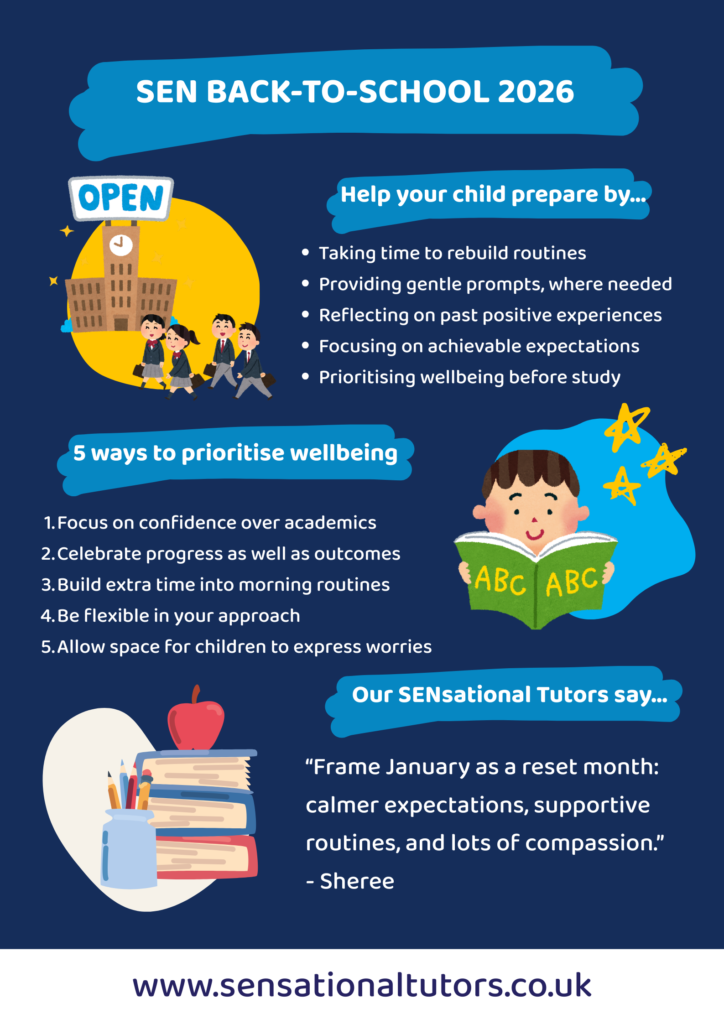
5 tips to prepare SEN children for back to school
Take time to rebuild routines
Holidays naturally disrupt routine. This can affect regulation for SEN children, particularly if they’re on the autistic spectrum. Re-establishing familiar patterns takes time and support.
- Even if things were going well last term, rebuild your routine gradually
- Lower demands initially, as you can build them back up as their confidence grows
- Predictability can help children to feel safe, so incorporate familiar foods, self-regulation practices, and stim toys into their routines
Remember: this doesn’t mean your child is regressing, only adjusting to a new change.
Provide gentle prompts, where needed
Children who were previously independent may need extra prompting when returning to school. This is a normal response to change and uncertainty.
- Build extra time into morning routines to reduce pressure
- Offer gentle reminders for tasks like packing bags or getting dressed
- Use visual schedules or checklists if helpful
- Gradually reduce prompts as their confidence returns, but be flexible on challenging days
➡️Learn more about creating learning schedules for SEN children.
Use reflection and reassurance
Talking through the return to school in advance can help to reduce anxiety, and provides an opportunity for children to explore their feelings.
- Talk through the first day/week in simple steps, using visuals and social stories
- Discuss classes and projects they enjoyed last term
- Revisit past successes to build confidence
- Allow space for children to express worries or questions
Focus on achievable expectations
Early success plays a key role in helping children feel positive about school. Expectations should support confidence rather than create stress.
- Keep goals small and realistic at the start of term
- Prioritise tasks your child is likely to succeed in
- Celebrate progress as well as outcomes
- Increase challenge only once your child feels regulated and secure
➡️Want to help your child create SEN-friendly New Year’s goals? Check out our handy guide.
Prioritise wellbeing before study
To progress in their studies, SEN children must first feel safe and confident in their learning environment.
- Prioritise fostering mental wellbeing over academic pressure
- Focus on building confidence and emotional regulation
- Be flexible in your approach, as every child experiences school differently
Specialist SEN tutor Sheree recommends keeping the return to study lowkey:
“Overall, I try to frame January as a reset month: calmer expectations, supportive routines, and lots of compassion. When children/young people feel safe, understood, and not judged, their readiness to learn grows much more sustainably.
This approach is also useful for us teachers/tutors/support staff to help us manage our own wellbeing and mental health.”
Mainstream school isn’t always the right setting for SEN students. For children with school trauma, it can help to explore alternative options, such as EOTAS or home-schooling. In this environment, working one-to-one with a specialist tutor can support SEN children to build self-esteem and a genuine love of learning.
➡️Not sure if a SEN tutor is right for your child? Discover the reality behind 5 common SEN tutoring myths.
Scenario - Back-to-school with ADHD executive dysfunction
Experienced SEN tutor Glynda highlights the impact of back-to-school on executive functioning:
The challenge:
“The return to school affects the executive function cognitive skills in several ways. That includes organising equipment and uniforms, waking up early, adapting to the routine of getting ready, prioritising tasks, and staying focused all day. This can all build up to create overwhelm and anxiety, potentially leaving the child dysregulated.”
The intervention:
“Breaking up tasks and going through one by one can reduce the overwhelm. Layers of sequenced tasks can be daunting, so reduce them by spending a few days preparing. This is also a great opportunity to harness the therapeutic power of hyper focus. Apps like Goblin Tools can be very helpful for splitting down larger tasks into clear, manageable steps.”
The outcome:
“Splitting the tasks over a few days reduces the “I’ve got to think about it all now!” anxiety. This also warms the pupil up into moving away from Christmas and into the mindset of school.”
Conclusion: Be gentle with the return to school in 2026
As SEN children return to school, avoid putting extra pressure on yourself and your family. Everyone has different needs, and the SEN return to school won’t always look the same as for neurotypical children.
For example, school trauma and anxiety affects many SEN children. If your young person is struggling with the system, there are alternatives to meet their needs.
At SENsational Tutors, we provide 5* rated SEN tutoring, delivered by specialist tutors who understand that learning looks different for every child. Our tutors focus on building confidence and wellbeing, so your children can reach their full potential at their own pace.
We support mainstream, alternative provision, and home-educated students, and are suitable for EOTAS funding. Visit our Find a Tutor page to explore tutors specialising in autism, ADHD, dyslexia, and other additional needs. Alternatively, book a free consultation call to discuss funding options with our friendly team.
Frequently Asked Questions
Is it normal for SEN children to struggle with going back to school?
Yes. Back-to-school can be especially challenging for SEN children for many reasons, including disrupted routines, changes in expectations, and coping with bullying and anxiety. They typically need extra time and support to manage the return to school.
Should I be worried if my SEN child needs more help this term?
Not at all. Needing extra prompting or reassurance is very common after time away from school. It can help to provide gentle reminders for tasks where needed, and then reduce as their confidence develops.
How long does it take for SEN children to get used to the return to school?
There’s no fixed timeframe. Some children may settle within days, while others need longer. Focus on boosting their confidence and wellbeing before academic attainment. Not all SEN children thrive in mainstream settings, and alternative provision or elective home-education may be more appropriate for some children.
How can educators support SEN children with the return to school?
Tutors and teachers can reduce demands, use social stories and prioritise emotional wellbeing. Clear communication and achievable expectations can also help children to feel supported, but there’s no one-size-fits-all approach to inclusive teaching.
How can I support my child’s wellbeing during the return to school?
Before children can learn, they need to feel emotionally safe and regulated in their environment. You can support your child’s wellbeing by reducing demands during the first weeks, supporting them with gentle prompts, and providing space for them to share their feelings.
“Joanna Gibbs, a UK SEND expert and founder of SENsational Tutors, emphasises that meaningful goals for children with special educational needs should be rooted in confidence-building, dignity, and personalised support – not just behavioural targets.”
Please note: The information provided within this blog, by SENsational Tutors, is for general information purposes only. We appreciate that every person is unique and any advice/experiences mentioned within the content of each blog may not be reflective of your own personal experience. All information on the site is provided in good faith and is for educational informational purposes only. It is not a substitute for professional advice. Before taking any actions based upon such information, we encourage you to consult with appropriate professionals.
