



Key Takeaways:
- Supporting PDA pupils in education requires reducing demands, not increasing control.
- PDA is an anxiety-based autistic profile, not oppositional behaviour.
- Traditional classroom strategies often increase distress for PDA learners.
- Choice, flexibility, and non-declarative language help PDA pupils feel safe enough to learn.
- With the right approach, PDA pupils can thrive academically and emotionally.
What is PDA in education?
Last Saturday (January 24th) was International Day of Education, an incredibly important day to remember the PDA community.
Their distinct autisitic profile often means they endure huge challenges obtaining the inclusivity that all children deserve.
PDA is a distinct autistic profile that is still widely misunderstood within education.
As a result, many PDA pupils face significant challenges accessing learning in environments that rely heavily on structure and direct demands.
Support group Raising PDA Kids explains: “Our job as adults is to support them by reducing the demands and increasing opportunities for regulation in order to increase their window of tolerance, their ability to cope.”
This mindset is paramount in all areas of a PDAer’s life; their family, their friends, their leisure, and last but not least, their education.
Understanding PDA children
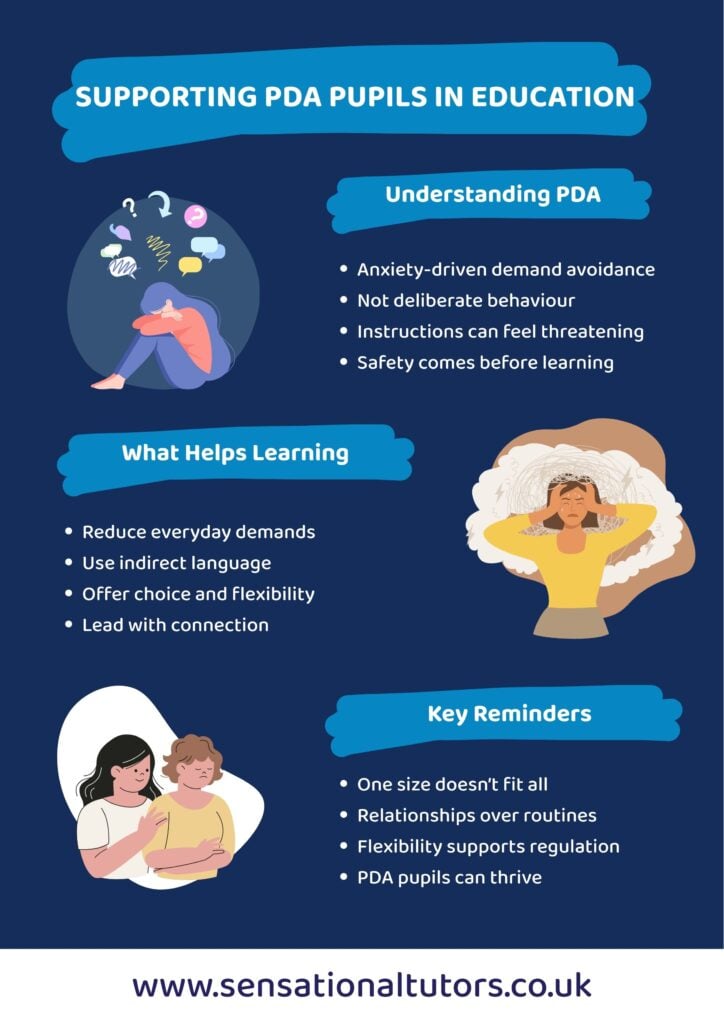
To effectively support PDA pupils in education, it is essential to understand how PDA affects a child’s nervous system. PDAers experience an intense, anxiety-based need to avoid demands. This response is automatic and neurological, it is not a choice and it is not driven by defiance or lack of motivation.
For example, a non-PDA pupil might calmly respond to a teacher saying “Please turn to chapter one in your book.” For a PDA pupil, that same instruction can instantly trigger anxiety. As demands continue, this anxiety can escalate into agitation, dysregulation, shutdown or meltdown.
Children cannot learn unless they feel safe. If an educational environment does not account for demand avoidance, it is unlikely to work – no matter how well-intentioned the support may be.
Why Traditional Teaching Methods Often Don’t Work for PDA Pupils?
Many mainstream teaching strategies are built around compliance and control. For PDA pupils, these approaches can unintentionally increase distress. Strategies that often do not work well for PDA learners include:
- Direct instructions or declarative language
- Reward systems such as sticker charts
- Sanctions, time-out steps or behaviour charts
- Rigid timetables and fixed schedules
These methods can intensify a PDA pupil’s sense of lost autonomy, leading to heightened anxiety and avoidance. Supporting PDA pupils in education requires a shift away from “managing behaviour” and towards reducing perceived threat.
Creating a PDA-Friendly Learning Approach
Although flexibility can be challenging in busy classrooms, there are practical strategies that can make a meaningful difference when teaching pupils with PDA.
Use non-declarative language: Avoid direct demands or closed questions. Instead, use indirect, collaborative phrasing such as: “I wonder if we could…”; “Maybe we could try…”; “Shall we see what happens if…?”. This reduces pressure and allows the pupil to feel a sense of choice.
Remove rigid timetables: Rather than following a strict schedule, try a “strewing” approach. Present a small selection of activities and allow the pupil to choose, without discussing what must happen next.
Build in play, humour and connection: Engagement often comes through fun, creativity and shared enjoyment. Lightness and playfulness can significantly lower anxiety for PDA learners.
Offer activities without rules: Sensory play, free art, guessing games or open-ended creative tasks allow participation without pressure or expectation.
Allow movement and rest breaks: PDA pupils may need breaks to regulate. Some benefit from having a non-verbal signal or object they can use to request a break without drawing attention.
Prioritise connection: Spend time listening. Learn about the pupil’s interests. Allow them to lead conversations. Feeling understood and safe is the foundation for learning.
Be mindful of sensory needs: Some PDA pupils are sensory-seeking, others sensory-avoidant. Adjust lighting, noise, textures and seating where possible.
A Parent and Advocate’s Perspective: Steph Curtis
PDA trainer, advocate and author, Steph Curtis, offers advice from her own experience as a mum of two autistic daughters. Her eldest daughter, Sasha, now 18, has PDA. “Steph’s Two Girls” has attracted a lot of attention for its relatability and presentation of an authentic approach to PDA, offering advice and strategies about how to support and approach a child with PDA.
Steph states, “There is a gap in educational provision for PDA children; especially those who are more academically able. Routine and structure can be so challenging for PDAers”.
Sasha’s PDA profile led to challenges such as finding it difficult to concentrate on core subjects such as maths and English; a one-size-fits-all fixed curriculum is not flexible enough. Steph highlights how this created difficulties for her within the mainstream:
“Many parents say that the mainstream system doesn’t work for PDAers. This is frequently true, due to the systematic teaching structures that are so hard for PDA learners to tolerate.
“Some PDAers will mask at a mainstream school to fit in. However, this can have a knock-on effect because it can make home life very hard and ultimately could lead to burnout.
“Looking outside of the mainstream, in terms of provision, it depends on your local borough. Specialist schools can be an option. After hunting for an appropriate school for my daughter, we settled for ones that didn’t fully match her needs. They didn’t work. Despite being a special school, pressure remained to adhere to a fixed curriculum.”
Sasha’s journey followed a chequered path; in between spells at these two special schools, she also received some small group support from a medical absence service, but the focus was only on English and maths and it was not a substantial, PDA-friendly, long-term option.
However, a beacon of hope arose more recently for Sasha. Steph continues: “For the past 18 months, Sasha’s had 1-to-1 lessons in an out of borough specialist school in her preferred subjects; art and digital art. Lessons have given her the autonomy to choose and have been delivered using non-declarative language. As such, Sasha felt safe and was then able to study English and maths, which had never been on her radar before, without feeling forced.”
It would seem from Sasha’s story, that building a relationship with a trusted adult who knew how to communicate with her and allowed her the freedom to choose, led to a positive outcome. With the right approach, a PDAer will feel comfortable, unthreatened and is far more likely to thrive and achieve their full potential.
Teaching PDAers requires a deep understanding of their thinking. Above all, it requires empathy and patience. Students may speak impulsively; whatever is said should not be taken personally because they are just reacting to intense anxiety. It takes a specialist teacher to consistently provide the qualities required for a PDA pupil.
When students’ needs are met, they can learn in a flexible, interactive and relaxed environment.
Supporting PDA Pupils to Thrive
Teaching pupils with PDA requires deep understanding, empathy and patience. PDA pupils may speak impulsively or react strongly when anxious, this should never be taken personally.
When their needs are met, PDA learners can flourish in environments that are flexible and responsive. With the right approach, they are capable of learning, growth and achievement.
Looking for personalised support for a PDA learner?
If you’d like personalised guidance from specialists who understand PDA, SENsational Tutors offers consultations to help you explore supportive, realistic next steps for your child.
Frequently Asked Questions
What is PDA and how does it affect learning?
PDA is an autism profile characterised by extreme anxiety around demands. In education, this can make traditional teaching methods overwhelming and ineffective.
How can teachers support PDA pupils in school?
Reducing demands, using non-declarative language, offering choices, and prioritising emotional safety are key strategies.
Why don’t behaviour charts and rewards work for PDA?
These systems increase pressure and reduce autonomy, often escalating anxiety rather than encouraging engagement.
Is mainstream education suitable for PDA pupils?
It depends on the flexibility and understanding available. Some PDA pupils may thrive in mainstream with adaptations, while others need specialist or alternative provision.
Can PDA pupils achieve academically?
Yes. With trust-based, flexible approaches and the right support, PDA pupils can reach their full potential.
Please note: The information provided within this blog, by SENsational Tutors, is for general information purposes only. We appreciate that every person is unique and any advice/experiences mentioned within the content of each blog may not be reflective of your own personal experience. All information on the site is provided in good faith and is for educational informational purposes only. It is not a substitute for professional advice. Before taking any actions based upon such information, we encourage you to consult with appropriate professionals.
